

Can Radiofrequency Melt Facial Fat? What the Evidence Shows
Evidence vs Marketing
No time to read — key facts
Key facts from this article
Yes, RF can affect fat—but “RF” describes several very different treatments.
A professional fat-contouring system reduced measured lower-face volume in a small study of 14 women. Another experiment in five abdominoplasty patients showed that prolonged, deep RF heating could produce delayed fat-cell injury. These were professional systems designed to heat deeper tissue, not ordinary home facial devices.
The FDA warning about fat loss concerns RF microneedling, where needles deliver energy into or below the skin. It should not be rewritten as a warning that every non-needle home RF device melts facial fat.
For home RF, the evidence is frustratingly thin. A Silk’n study found no visible fat atrophy over 18 weeks, but investigators did not image the fat. A later AMIRO combination study measured a roughly 26–27% reduction in periorbital subcutaneous-tissue thickness at week eight. The device also used red light and arbutin cream, there was no control group, and the change appeared mainly after treatment stopped. It is a result worth investigating—not proof that home RF destroyed facial fat.
Staying below 43°C is not a complete safety guarantee because the number usually describes surface temperature. Tissue response also depends on treatment time, depth, electrode geometry, movement, cooling and total energy delivered.
Bottom line: legitimate temperature-controlled home RF is a different and generally more limited exposure than professional fat-contouring RF or RF microneedling. Short-term studies have not shown a pattern of visible facial hollowing, but facial fat has been measured too rarely—and for too little time—to calculate the risk or honestly call it zero.
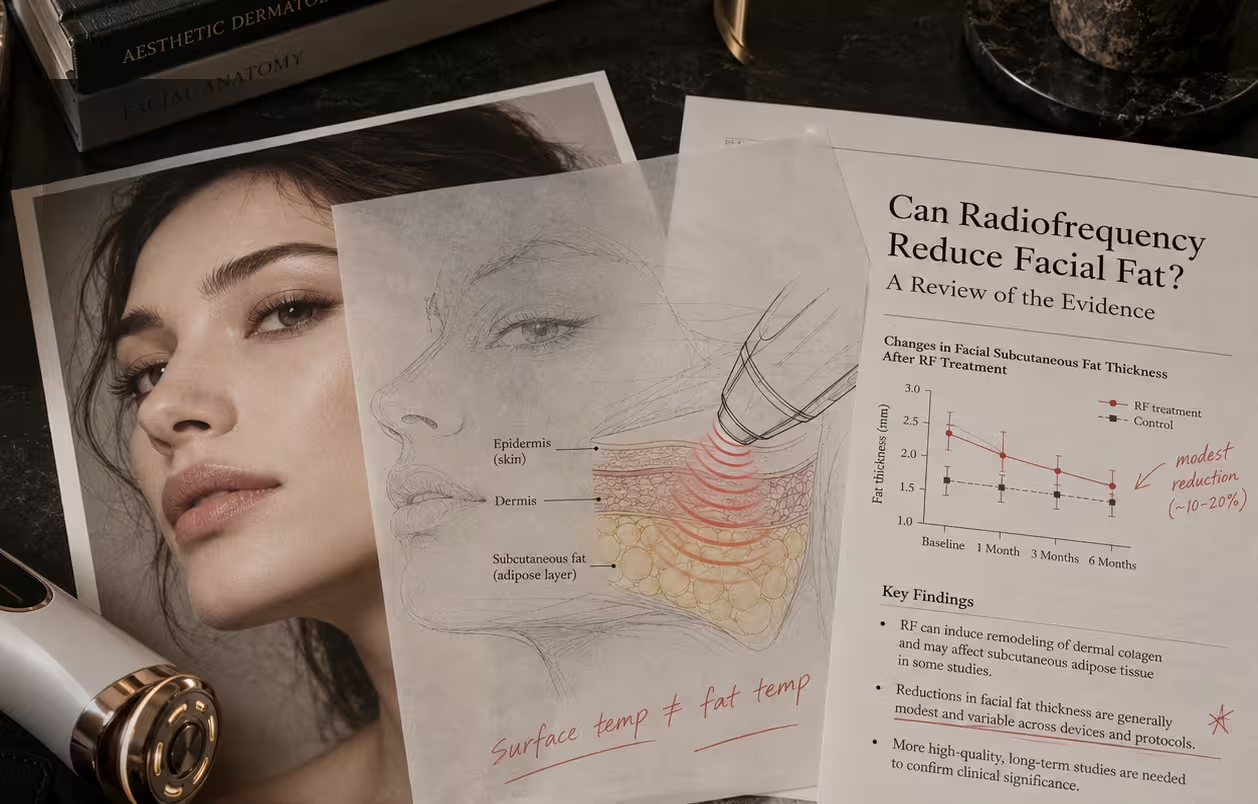




Short answer: yes, some medical radiofrequency systems can heat subcutaneous fat enough to injure adipocytes, and a small professional facial study reported measurable lower-face volume reduction. The FDA also lists fat loss among the serious complications reported after RF microneedling.
But that does not mean every treatment called “RF” carries the same risk. A fat-contouring machine, an RF microneedling platform, a probe placed under the skin and a €350 home device deliver energy in very different ways.
For home RF, the honest answer is less satisfying: direct facial-fat safety evidence is extremely limited. The published trials are reassuring about short-term burns and pain, but most did not image fat. No study has followed people using a home facial RF device weekly or monthly for years.
So “RF cannot affect facial fat” is false. “Home RF melts your face” is also unsupported. The settings, depth, electrode geometry, treatment time and device type are the point.
Evidence search updated September 16, 2026. This is an independent review of papers and official FDA records, not a sponsored article.
The most useful details below are the differences between the four RF categories, what the studies actually measured, and why one surprising home-device ultrasound result remains unresolved.
First: four different treatments are all called RF
| Type of RF | How the energy is delivered | Can it reach or affect fat? | Is this a home treatment? |
|---|---|---|---|
| Home surface RF | Electrodes rest on intact skin; legitimate studied or cleared devices limit output and temperature | Direct evidence is sparse. A limited output does not prove zero effect, but this is not equivalent to a fat-contouring system | Yes |
| Professional surface RF | Monopolar, bipolar or multipolar applicators heat tissue through intact skin; some systems are designed specifically for deeper or adipose heating | Yes. Human histology and facial-volume studies show that selected systems and doses can affect subcutaneous tissue | No |
| RF microneedling | Needles place electrodes into the dermis; depth, energy per needle and pulse width determine the thermal zone | Yes, unintentionally, if treatment reaches or thermally spreads into subcutaneous fat. The FDA has received reports of fat loss | No; the FDA calls it a medical procedure |
| Subdermal RF / RF-assisted lipolysis | A cannula or electrode is inserted beneath the skin | Yes—fat coagulation or reduction may be part of the intended contouring effect | No; it is an invasive medical procedure |
This is why a paper about one category cannot be used as proof for another. The frequency in megahertz is only one specification. Power, current path, electrode distance, active cooling, target depth, pulse duration, number of passes and total thermal dose all matter.
“Melt” is a useful search word, but not a precise biological description
RF does not make facial fat run like butter.
RF energy produces heat in tissue. At a sufficient temperature for a sufficient time, adipocytes can be injured. The subsequent response can include vascular changes, inflammation, delayed cell death and gradual clearance. A smaller measured volume may also reflect tissue contraction, fluid change or repositioning—not necessarily destroyed fat cells.
That distinction matters when reading studies:
- Histology can show adipocyte injury or necrosis.
- Ultrasound or MRI can measure the thickness of a fat or subcutaneous layer.
- 3D photography can measure a change in external volume, but cannot tell us which tissue changed.
- “No visible atrophy” means that investigators did not see hollowness. It is not the same as imaging the fat compartments.
The clearest evidence that professional RF can injure fat
The most direct human evidence comes from a 2010 feasibility study of a professional Cutera RF system—not a facial device and not a home device.
Researchers first exposed cultured human adipocytes to different time-temperature combinations. After one minute, cell viability fell from 89% at 45°C to 20% at 50°C. Three minutes at 45°C left 40% viable, meaning a 60% reduction in viability.
They then treated abdominal tissue in five adults undergoing abdominoplasty. Age, sex and race were not reported. Two patients received a short three-minute treatment during surgery so investigators could measure immediate tissue temperatures. Three received a 22-minute treatment before surgery, allowing tissue to be removed and examined 4, 9, 10, 17 or 24 days later.
The results make two points clear:
- During the short treatment, fat reached approximately 45°C at 7 mm and 50°C at 12 mm, while the cooled skin–fat interface remained below 30°C.
- In the longer-treatment group, modelling estimated that subcutaneous tissue remained around 43–45°C for 15 minutes. Histology was normal immediately after treatment, but vascular changes appeared from day four and adipocyte necrosis was observed from day nine, at depths between 4.5 and 19 mm.
This is important because it shows why a single temperature number is misleading. Tissue response depends on temperature × time × depth, and surface temperature may not equal fat temperature.
It is also a very small feasibility study of abdominal tissue. It does not establish a universal threshold for the face or for home devices.
Funding/conflict note: the paper did not provide a modern funding or conflict statement. The device was made by Cutera, and two of the five authors were affiliated with Cutera. (Franco et al., 2010 | PubMed)
A professional surface RF study deliberately reduced lower-face volume
In 2017, Sugawara and colleagues used a truSculpt 1 MHz monopolar RF body-contouring system on the lower face. This is unusually relevant because fat reduction was an intended outcome, not an adverse-event question.
The study included 14 Asian women, mean age 44.6. They received stationary applications to the buccal and nasolabial areas once a week for five weeks. The first treatment was set to 44°C and later treatments to 45°C. Investigators used VECTRA 3D photography before treatment and through two months after the final session.
More than 90% of participants showed a treated-area volume reduction, with a reported average of 2.7 mL. Sixty percent were satisfied or very satisfied with tightening. Mild redness lasted a few hours; the authors reported no swelling, induration, burns, sensory disturbance or facial paralysis.
This demonstrates that a professional, stationary, fat-contouring RF protocol can reduce measured facial volume. But the study had only 14 participants, no control group and only two months of follow-up. It used surface 3D imaging—not ultrasound, MRI or facial-fat histology—so “2.7 mL of fat destroyed” would be stronger than the measurement allows.
Funding/conflict note: the accessible abstract and publisher record do not state a funding source or conflict declaration. The named system was manufactured by Cutera. (Sugawara et al., 2017 | PubMed)
RF microneedling is the category with an explicit FDA warning
On October 15, 2025, the FDA issued a safety communication after receiving reports of serious complications from certain uses of RF microneedling. The list included burns, scarring, nerve damage, disfigurement and fat loss. Some injuries required medical or surgical treatment.
The FDA was specific about the category: these devices use arrays of needles to deliver RF energy into or under the skin. It described RF microneedling as a medical procedure and said the devices should not be used at home.
This warning should not be silently rewritten as “the FDA says all RF causes fat loss.” It does not address ordinary non-needle home facial RF. (FDA safety communication, October 15, 2025)
What the post-market reports can—and cannot—tell us
A 2026 analysis searched the FDA’s MAUDE adverse-event database from January 2013 to October 2025. It found 114 reports containing 224 events associated with RF microneedling. The most frequently coded events were textural change (56; 25.0%), pigment alteration (41; 18.3%) and fat loss (26; 11.6%). Burns accounted for 14 events (6.3%). The face, neck and abdomen were the most commonly treated regions.
Those percentages describe the mix of events within submitted reports. They are not complication rates. MAUDE does not tell us how many total treatments were performed, and passive surveillance is affected by under-reporting, duplicate or incomplete records and reporting bias. We cannot say that 11.6% of RF microneedling patients lose fat.
The value of the database is different: it documents that the FDA received reports coded as fat loss, rather than leaving the concern at the level of internet anecdote. It cannot by itself prove that the device caused every reported event.
Funding/conflict note: all three authors were affiliated with the Dermatology Cosmetic and Laser Center at Massachusetts General Hospital and Harvard Medical School. The accessible PubMed record does not state funding or conflicts of interest. (Chou, Myers and Avram, 2026)
A separate 2026 narrative review explains why settings matter. RF microneedling typically operates at 1–4 MHz, while needle depth, energy per needle and pulse width shape the thermal injury. In the histology arm of a 2025 dose–response study, ex-vivo porcine skin was treated at 20–100 mJ per needle; energy per needle correlated strongly with coagulation volume (r = 0.976, P < 0.005). The study’s separate human arm included 30 patients, but used 3D imaging rather than histology. Thermal effect can extend beyond the needle tip, which is particularly relevant in thin periorbital and malar tissue.
That review received no funding and its authors declared no competing interests. It also acknowledged that the literature is dominated by small cohorts and case series rather than trials designed to calculate uncommon harms. In the 2025 dose–response paper, two authors disclosed lecture fees from Lutronic and one author was Lutronic’s chief technology officer. (Varelas et al., 2026 | Nguyen et al., 2025)
What do home RF studies tell us about facial fat?
Very little. That is the most important finding.
| Home device evidence | Participants and schedule | What was measured about fat? | What we can conclude |
|---|---|---|---|
| Silk’n HST (RF + red/infrared LED) | 33 enrolled, 30 completed; mostly women; mean age 53.3. Every other day for six weeks, then two monthly sessions | Investigators reported no externally visible subcutaneous fat atrophy. No ultrasound or MRI was used | Reassuring visual observation over 18 weeks, but not a quantitative fat-safety study |
| AMIRO ARF001 + red light + 7% arbutin | 38 women; mean age 44, range 28–60; Fitzpatrick II–IV. Three times weekly for four weeks, then device and cream stopped for four weeks | Ultrasound measured periorbital dermal and subcutaneous tissue thickness at 0.5 and 1 cm from the lateral orbital rim | A large delayed reduction in subcutaneous thickness was recorded, but the uncontrolled combination design cannot show whether this was fat loss, tightening, measurement variation, RF, red light or the cream |
| CurrentBody Skin RF FDA file | No clinical efficacy or fat-safety cohort for the exact device | Bench testing, porcine-skin thermal comparison and human-factors testing—not facial-fat imaging | FDA clearance supports substantial equivalence and engineering safety; it is not clinical proof of zero fat effect |
The AMIRO result deserves attention—not a dramatic headline
The 2025 AMIRO study is the only home-use paper we found that directly measured subcutaneous tissue thickness around the eye.
At 0.5 cm from the outer orbital rim, mean subcutaneous tissue thickness was 1.44 ± 0.36 mm at baseline, 1.52 ± 0.37 mm at week four and 1.07 ± 0.56 mm at week eight. At 1 cm, it was 1.59 ± 0.42 mm, 1.62 ± 0.36 mm and 1.16 ± 0.58 mm, respectively. The reported overall time effects were significant (P < 0.001 at both sites).
In other words, the layer was not thinner at the end of active treatment; most of the difference appeared during the four weeks after the device and cream had been stopped. Compared with baseline, week-eight means were approximately 25.7% and 27.0% lower.
The authors described this as a tightening effect on subcutaneous fat. We think the result is more uncertain:
- “Subcutaneous tissue” is not the same measurement as isolated fat-compartment volume or adipocyte death.
- There was no untreated side, sham device, RF-only group, red-light-only group or cream-only group.
- Only two periorbital points were measured.
- The standard deviations were large at week eight.
- The late change could reflect biology, measurement variability or both.
- The study was not designed to diagnose unwanted facial lipoatrophy.
No adverse events were reported, and participants were satisfied. But satisfaction cannot tell us whether a 26–27% thinner periorbital subcutaneous measurement is desirable, neutral or reproducible.
Funding/conflict note: Accompany Tech Co. Ltd., the maker of AMIRO, funded the study. The authors were based at Chengdu Second People’s Hospital, Shanghai Jiao Tong University and Zhejiang University, and declared no conflicts of interest. Industry funding does not make the result false; it makes independent replication especially valuable. (Zhang et al., 2025)
What the Silk’n paper did—and did not—exclude
The Silk’n HST study reported that no subcutaneous fat atrophy was detected externally after 21 treatments in six weeks and two monthly maintenance treatments. That is useful. It also used a device reaching a stated maximum of 43°C without observing clinical hollowing over 18 weeks.
But the device combined RF with red and infrared light, the study was uncontrolled, and fat was not measured with ultrasound or MRI. The trial was supported by Home Skinovations, and one author was company-affiliated.
Its correct conclusion is narrow: investigators did not observe visible atrophy in 30 completers over the study period. It cannot prove that the fat layer never changed or that indefinite maintenance is risk-free. (Gold et al., 2017)
Does staying below 43°C make home RF fat-safe?
Not by itself.
A device’s displayed or permitted surface temperature is not a direct measurement of every deeper tissue layer. The 2010 professional Cutera experiment deliberately cooled the skin while heating fat much more strongly. That does not mean a home device behaves the same way; it proves that electrode design and current path can separate surface and deep temperatures.
The CurrentBody Skin RF 510(k) file specifies a maximum permitted temperature of 40.5 ± 0.5°C, 1 MHz bipolar RF, maximum output of 5 ± 1 W and estimated penetration of approximately 0.5 cm. It also says no clinical testing was performed on the exact device. CurrentBody’s consumer material has used 43°C, while the regulatory file gives the lower number.
NEWA’s published system used a sensor that stopped RF delivery above 42°C. Silk’n reported a maximum of 43°C. These limits and motion sensors are sensible safeguards against overheating. They still do not substitute for a study that images facial fat before and after years of repeated use.
So the useful question is not simply “Is it under 43°C?” It is:
What temperature-time dose reaches which tissue, with this electrode geometry, while the device is used exactly as directed?
(FDA 510(k) K232424 for CurrentBody Skin RF)
What about weekly or monthly home RF for years?
We found no study that answers this.
Home trials generally used intensive schedules for four to twelve weeks. The Silk’n paper added two monthly maintenance treatments, and some studies followed participants for a few months. None used serial ultrasound or MRI to track facial-fat compartments during weekly, ten-day or monthly treatment over multiple years.
That leaves two separate uncertainties:
- Cumulative efficacy: we do not know whether years of maintenance preserve a fixed amount of tightening.
- Cumulative fat safety: we do not know whether a small tissue effect, if one exists, remains stable or accumulates with repeated exposure.
Absence of a long-term signal in small short trials is reassuring only within those limits. It is not evidence that unlimited use is risk-free.
For study schedules and the actual wrinkle and elasticity results, see our independent review of home RF devices.
How to think about risk without panicking
The current evidence supports a proportionate approach:
- Do not equate home RF with professional fat-contouring RF. Output, geometry, depth and thermal dose differ.
- Do not equate surface RF with RF microneedling. The FDA warning concerns needles delivering energy into or below the skin.
- Use only the areas, gel, movement and schedule specified for the exact home device. Do not copy clinic settings or multiply sessions because a paper used another system more frequently.
- Temperature and motion cut-offs matter. A stationary applicator can create a very different local dose from a continuously moving one.
- Be cautious around thin tissue. Do not improvise treatment on eyelids or very close to the eye when the manual excludes those areas.
- Persistent pain, blistering, numbness or a new asymmetric hollow is not an expected “purge.” Stop treatment and seek assessment from an appropriately qualified clinician.
- For professional treatment, ask what the device is intended to heat. The device name, electrode type, needle depth, energy, passes and whether fat reduction is intended are more informative than the word “RF.”
If an injury follows RF microneedling, the FDA asks patients and clinicians in the United States to report it through MedWatch. Other countries have their own medical-device reporting systems.
Our bottom line
Professional RF can affect facial fat. One small lower-face study deliberately produced an average 2.7 mL external volume reduction with a professional monopolar system, and human abdominal histology shows that a sufficiently long, deep thermal exposure can cause delayed adipocyte necrosis. RF microneedling also has a documented post-market fat-loss signal and an explicit FDA warning.
For ordinary home surface RF, we cannot calculate the risk. The studied or cleared home devices described here use limited output and are engineered differently from the professional fat-contouring system, and short-term studies have not shown a pattern of visible facial atrophy. But most studies never measured fat. The one home combination study that did use ultrasound found a surprisingly large reduction in periorbital subcutaneous tissue thickness four weeks after treatment stopped—and its design cannot tell us exactly what changed or why.
The evidence therefore supports neither reassurance by slogan nor fear by association:
Home RF is not the same exposure as professional fat-contouring RF or RF microneedling. For legitimate temperature-controlled home devices, the exposure is generally more limited—but facial-fat risk has not been measured well enough, or long enough, to quantify it or call it zero.
Sources
- Franco W, et al. Hyperthermic injury to adipocyte cells by selective heating of subcutaneous fat with a novel radiofrequency device: feasibility studies. 2010. PubMed | Publisher/DOI
- Sugawara J, et al. Application for lower facial fat reduction and tightening by static type monopolar 1-MHz radio frequency for body contouring. 2017. PubMed | Publisher/DOI
- Gold MH, et al. Safety, efficacy, and usage compliance of home-use device utilizing RF and light energies for treating periorbital wrinkles. 2017. Publisher/DOI
- Swanson E. A Systematic Review of Subsurface Radiofrequency Treatments in Plastic Surgery. 2022. PubMed | Publisher/DOI
- Nguyen L, et al. Histological and clinical dose-response analysis of radiofrequency microneedling treatment for skin rejuvenation. 2025. PubMed | Full text at PMC
- Zhang L, et al. Effectiveness and Safety of Combined Use of Home-Based Radiofrequency Device and Arbutin Cream in Melasma and Facial Rejuvenation. 2025. Full text at publisher | PubMed
- U.S. FDA. Potential Risks with Certain Uses of Radiofrequency (RF) Microneedling—FDA Safety Communication. Issued October 15, 2025. FDA
- Chou M, Myers B, Avram M. Analysis of US Food and Drug Administration Data on Radiofrequency Microneedling Device Complications. 2026. PubMed | Publisher/DOI
- Varelas EA, et al. Complications of radiofrequency microneedling: a comprehensive review. 2026. Full text at publisher
- U.S. FDA. CurrentBody Skin RF 510(k) K232424. Cleared March 6, 2024. FDA summary PDF