
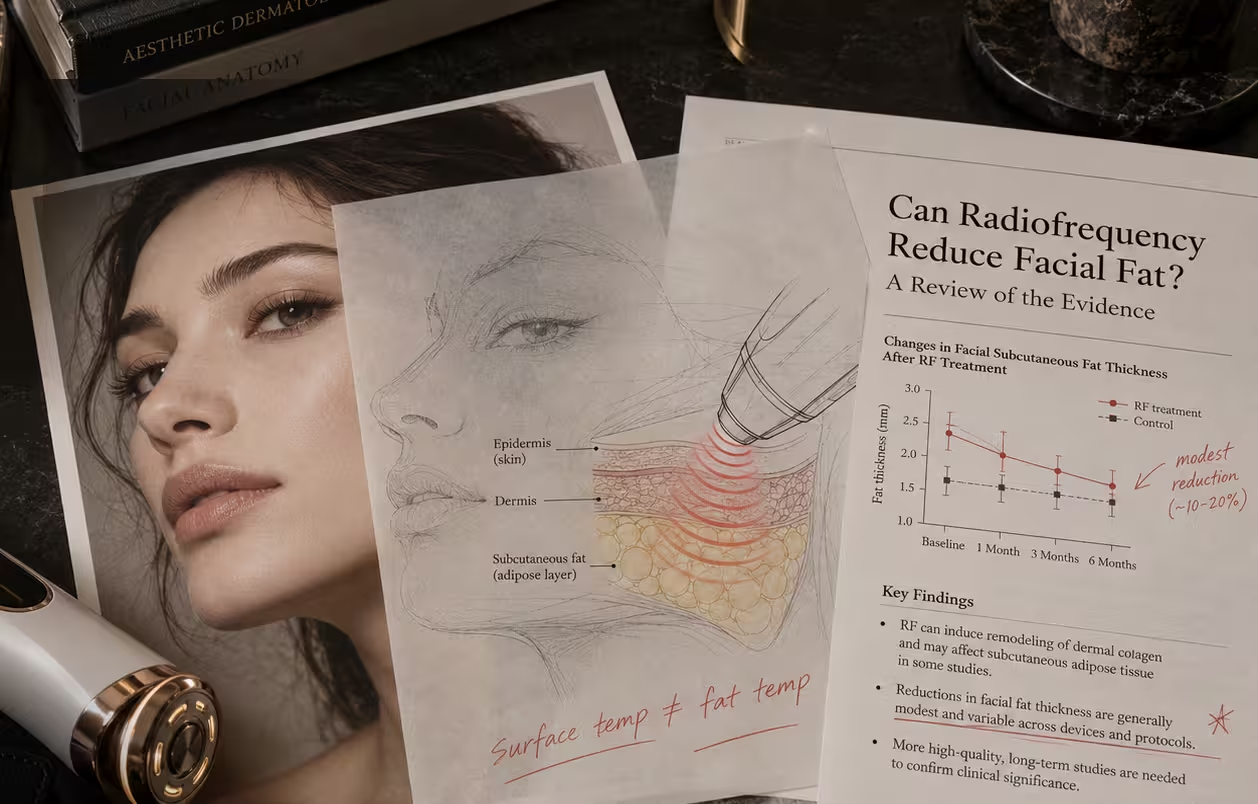

The GLP-1 Effect: How Ozempic Is Rewriting Patient Demand in Aesthetics
Analytics
No time to read — key facts
Key facts from this article
- Ozempic and its cousins finish the weight-loss job, then hand the patient a face they didn't sign up for: gaunter, hollower, older.
- The goalpost moves: 67% of weight-loss patients say their aim shifted from losing weight to looking better — and 63% have never set foot in an aesthetic clinic before.
- Fillers aren't dead — demand is higher than ever. But they're a visual fix, not a repair, and the clinics worth trusting say so out loud.
- The fastest-growing want is the patient's own tissue: fat grafting jumped ~50% in a year, and some patients now "bank" their fat before the weight comes off.
- The counterintuitive twist: most of these patients are spending less on aesthetics, not more — the drug eats the budget.
- The opportunity isn't a bigger appointment. It's a longer relationship — and it's won on honesty, not upselling.
The full picture, with the numbers and the why, is below.
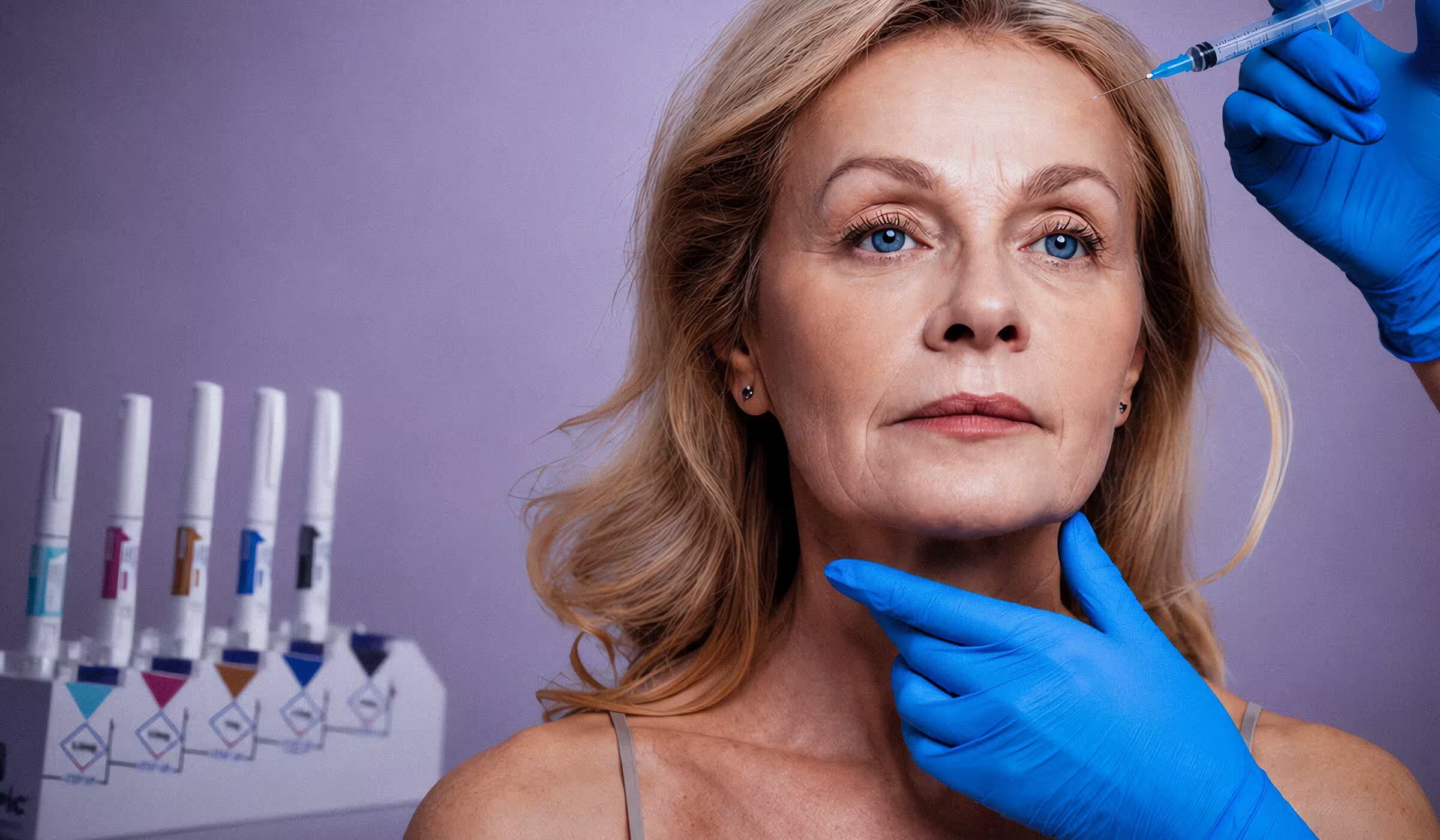




A drug built for diabetes and obesity finishes the weight-loss job — and hands the patient a new problem they didn't walk in with. That handoff, repeated across millions of people, is now one of the strongest forces shaping what aesthetic clinics are asked to do.
The scale, and the shift it set off
By late 2025, an estimated 31 million US adults had taken a GLP-1 drug, a rising share of them for weight loss rather than diabetes. But the number that matters for aesthetics isn't a prescription count — it's a change of intent. In medical-weight-loss patients, **67% say their goal moved from losing weight to improving how they look.**¹ The drug solves the problem they came for, then surfaces a different one in the mirror.
That second problem is overwhelmingly facial. Among GLP-1 patients, 61% develop midface volume loss, 50% skin laxity, and 35% deeper wrinkles and folds.¹ And the people arriving with it are not the usual crowd: 63% of GLP-1 patients seeking facial treatment had never used aesthetic medicine before — largely women aged 40–64 who were always the core demographic, now activated for the first time.² The same share arrive asking for help with several concerns at once, not a single line or fold — multimodal from the first consultation.² Ozempic isn't rewriting beauty standards. It's converting a vast group of weight-managing adults into first-time patients, all carrying the same complaint.
A note on names, since the brands split by region:
| Molecule | United States | Europe / UK |
|---|---|---|
| Semaglutide | Ozempic (diabetes), Wegovy (obesity) | Ozempic, Wegovy |
| Tirzepatide | Mounjaro (diabetes), Zepbound (obesity) | Mounjaro for both12 |
What the drug does — and the problem it creates
The mechanism behind "Ozempic face" is subtractive, and worth stating without the panic. In trials, patients lose roughly 15% of body weight, and fat leaves the face along with everywhere else.¹³ Facial fat compartments deflate faster than skin can retract, so the temples and cheeks hollow, the nasolabial folds deepen, and the jawline softens — the visual signature of aging, compressed into a few months. In one blinded assessment, patients after large weight loss were judged to look about five years older than their actual age.⁹
This is the editorial point clinics keep relearning: the loss is structural, not cosmetic-surface. It involves volume, support, and skin quality across the whole midface at once. That single fact is why demand is moving the way it is.
What patients are actually asking for
The instinct is to assume fillers fell out of favour. They didn't — and getting this right matters.
Hyaluronic acid is still the workhorse, and demand is up. 81% of providers name HA fillers (Juvéderm, Restylane; same brands EU and US) as their first-line tool for GLP-1 faces, with botulinum toxin (Botox) second, and a third of physicians say the drugs have increased the volume of filler they inject.¹,³ Patients arriving hollow simply need more replacement, and HA is the fastest, most controllable way to give it.
But it's worth saying plainly — to patients especially — that filler restores the appearance of volume without rebuilding what was actually lost. It softens hollows for a time and then fades; it doesn't replace the fat or shore up the support that deflated. That's not a reason to avoid it — it's a reason to set expectations early. The clinics serving these patients well are the ones explaining, up front, what filler can do, what it can't, and why one appointment rarely settles the matter.
But the growth — and the patient's stated preference — is bending toward "natural." Here's the number worth flagging for clinicians: even though total filler use stayed enormous (roughly 6.3 million US procedures in 2024), HA filler volume growth cooled to about 1% year-over-year — the quantitative tell that demand is shifting beneath a still-large headline count.⁶ Because the loss is structural and ongoing, a single syringe of gel is rarely the whole answer. Demand is migrating toward treatments that rebuild the patient's own tissue:
| What's rising | What it is | Why patients want it |
|---|---|---|
| Biostimulators — PLLA (Sculptra), CaHA (Radiesse); both EU & US | Stimulate the patient's own collagen rather than fill | Longer-lasting, more natural than gel; rebuild structure, not just volume. Hyperdilute Radiesse is now used to preserve volume during weight loss10 |
| Autologous fat transfer | Re-injects the patient's own harvested fat | The AAFPRS reported a ~50% rise in 2024, driven largely by weight-loss patients4 |
| Multimodal plans | Injectable + energy device + skin-quality work, staged | Over half of clinicians now combine treatments rather than treat in one visit, because the face keeps changing while the patient is still losing3,9 |
What's cooling is the opposite instinct — removing fat. The drug already does that. Submental "double-chin" injectables (deoxycholic acid: Kybella in the US, Belkyra in the EU/UK) target the exact fat patients are now losing on their own, and occupy a narrower niche than they did. Even liposuction is more complicated than the "it's dying" headline: it was the single most-searched procedure of 2024 (+144% year-over-year), because patients pair the drug with targeted contouring for areas it can't sculpt.⁸ Reduction didn't disappear — it stopped being the goal.
The body: the "Ozempic Makeover"
On the body the complaint is skin, not fat. Large, fast loss leaves loose tissue on the abdomen, arms, thighs, and breasts that diet and training can't reach — and among GLP-1 patients seen by ASPS surgeons, 39% were considering surgery and 41% a non-surgical procedure.⁶ Surgeons now have a name for the staged correction: the Ozempic Makeover.
| Procedure | Why demand is rising |
|---|---|
| Abdominoplasty (tummy tuck) | Loose abdominal skin, weakened wall |
| Brachioplasty (arm lift), thigh lift | Sagging skin that persists despite toning |
| Breast lift / augmentation | Deflation and drooping as breast fat is lost |
| Deep-plane facelift, neck lift, blepharoplasty | Sagging the needle can't fix; eyelid-surgery searches rose 84%8 |
| Full / circumferential body lift | Multi-area excess skin → staged, combined surgery |
One safety line belongs in any patient-facing copy: GLP-1 drugs slow gastric emptying, raising aspiration risk under anaesthesia, so most societies advise pausing them before surgery. Reassuringly, a 2026 single-center study of 1,002 post-weight-loss patients found complication rates tracked with BMI and metabolic health — not with how the weight was lost — though the GLP-1 subgroup within it was small, so read this as early reassurance, not the final word.¹⁴
The pull toward your own tissue — and "fat banking"
The clearest demand signal of all is the move from synthetic to biological. The autologous fat-grafting market is forecast to roughly double — from about $226M in 2025 toward $477M by 2035 — on a single named driver: a shift toward natural aesthetics and regenerative medicine, with **patients preferring their own tissue over synthetic fillers.**⁵
That preference is spawning new products and behaviours:
- Off-the-shelf own-tissue substitutes — adipose-matrix injectables like Renuva (MTF Biologics) and the newer alloClae (Tiger Aesthetics, late 2025) act as a scaffold the body fills with its own new fat. Both are primarily US; human-tissue allografts face stricter EU regulation.⁵
- Fat banking — harvesting and cryopreserving a patient's own fat before or early in weight loss, to reinject later once the volume is gone. It's a genuinely logical response to the GLP-1 timeline, and an early-stage one: long-term viability of thawed fat isn't well established yet, and patients should hear that plainly.¹¹
Why this demand doesn't fit the one-visit model
Here's the part most coverage misses, and the part that matters commercially.
The GLP-1 aesthetic problem is structural, ongoing, and arriving in a squeezed wallet. Two demand facts drive that home. First, the work is multi-step by nature — biostimulators need several sessions over months, the face keeps shifting during weight loss, and skin-quality work is a protocol, not an appointment.³,⁹ Second, and counterintuitively, 60% of GLP-1 patients have cut their overall cosmetic spending — the drug competes directly with their aesthetics budget.² Demand for treatment is up; discretionary money per visit is down.
A problem that unfolds over months, for someone counting every euro, doesn't fit a one-off filler appointment. It fits a plan — staged, explained, and priced so the patient knows what they're saying yes to before they say it.
For clinics, that's the real shift. The GLP-1 patient isn't someone who needs more filler; they're someone who needs the whole route mapped out — manage the weight, restore the face, work on skin quality, tighten or operate where the body needs it, then keep it up over time. Plenty of practices are already moving this way: 60% of GLP-1 patients now get the drug from a provider who also offers aesthetics, up from 49% a year earlier.¹
The opportunity isn't a bigger first appointment. It's staying someone's clinic for years — and that's earned with a real consultation, honest sequencing, and setting expectations from the start, not with the size of the first invoice.
And finally — what is a GLP-1 drug?
GLP-1 (glucagon-like peptide-1) is a gut hormone released after eating: it prompts glucose-dependent insulin release, slows stomach emptying, and signals fullness to the brain. GLP-1 receptor agonists mimic it but last far longer. Semaglutide (Ozempic, Wegovy) is the best known; tirzepatide (Mounjaro, Zepbound) goes further as a dual agonist, driving larger weight loss.¹²,¹³ The hollow cheeks and the first-time patient in the chair were never the point — they're the most visible side effect of the decade's most consequential metabolic medicines, and they're redrawing aesthetic demand in real time.
Sources
- Allergan Aesthetics (AbbVie). Allergan Aesthetics highlights Medical Weight Loss (MWL) data and the changing profile of patients [communiqué de presse]. 4 mars 2026. Disponible sur : https://news.abbvie.com/ (Source primaire, mais financée par l'industrie — Allergan fabrique des fillers à l'acide hyaluronique ; tendance corroborée par les réf. 3 et 9.)
- Jansen L, Peters N, Leclerc O, Davis L. GLP-1s are boosting demand for medical aesthetics. McKinsey & Company ; 15 mai 2025. [Enquête auprès de 174 medspas, cliniques de dermatologie/chirurgie plastique et autres praticiens américains, menée en déc. 2024.] Disponible sur : https://www.mckinsey.com/industries/life-sciences/our-insights/glp-1s-are-boosting-demand-for-medical-aesthetics
- Kaufman J, Dayan S, Boyd C, et al. Survey of facial aesthetic concerns and treatment trends following GLP-1 agonist-associated weight loss. Présenté au congrès annuel de l'ASDS ; nov. 2025 ; Chicago.
- American Academy of Facial Plastic and Reconstructive Surgery. Enquête annuelle 2024 [menée en déc. 2024 par ACUPOLL Precision Research ; env. 2 200 membres] : hausse d'env. 50 % des actes de lipofilling facial, attribuée en grande partie à la perte de volume liée aux GLP-1 ; 10 % des membres prescrivent désormais des GLP-1.
- Precedence Research. Autologous fat grafting market size, share and trends 2026–2035. Fév. 2026. Disponible sur : https://www.precedenceresearch.com/autologous-fat-grafting-market
- American Society of Plastic Surgeons. 2024 Procedural Statistics Report and GLP-1 patient report. 2025. [Source des chiffres patients GLP-1 et des volumes/croissance des fillers aux États-Unis : env. 6,3 millions d'actes d'acide hyaluronique en 2024, croissance d'env. 1 % sur un an.] Disponible sur : https://www.plasticsurgery.org/news/press-releases/
- International Society of Aesthetic Plastic Surgery. ISAPS Global Survey 2024. 2025. Disponible sur : https://www.isaps.org/discover/about-isaps/global-statistics/global-survey-2024-full-report-and-press-releases/
- RealSelf. Real Talk Report 2024 (données de recherche des consommateurs). Déc. 2024.
- Moradi A, et al. Nonsurgical aesthetic treatment of the face and neck in GLP-1 receptor agonist weight-loss patients: experience-based considerations. Aesthet Surg J Open Forum. Jan. 2026. Disponible sur : https://pmc.ncbi.nlm.nih.gov/articles/PMC12937588/
- Hyperdilute Radiesse preserves facial volume in GLP-1 receptor agonist users undergoing rapid weight loss. 2025. Disponible sur : https://www.ncbi.nlm.nih.gov/pmc/articles/PMC12538281/
- American Society of Plastic Surgeons. Rainy day funds: the fat banking era is here. Mars 2026. Disponible sur : https://www.plasticsurgery.org/news/articles/rainy-day-funds-the-fat-banking-era-is-here
- European Medicines Agency. Mounjaro (tirzépatide) : aperçu du médicament (EPAR). Disponible sur : https://www.ema.europa.eu/en/medicines/human/EPAR/mounjaro
- Wilding JPH, Batterham RL, Calanna S, et al. Once-weekly semaglutide in adults with overweight or obesity (STEP 1). N Engl J Med. 2021;384(11):989-1002.
- Abbott EN, Giannas E, Dorjsuren N, King D, Li R, Christopher A, Gergoudis F, Gabriel A, Perdikis G, Assi P. Post-weight loss body contouring surgery: complication rates following bariatric surgery, injectable GLP-1 pharmacotherapy, combination therapy, and lifestyle modification. Aesthet Surg J. 2026;sjag049. doi:10.1093/asj/sjag049. [Étude monocentrique, rétrospective ; sous-groupe GLP-1 = 7,8 % de la cohorte de 1 002 patients.]
Note éditoriale : les chiffres clés de demande (réf. 1, 2, 4) ont été vérifiés auprès de sources primaires — McKinsey (réf. 2) et l'enquête de l'AAFPRS (réf. 4) tiennent directement. La réf. 1 est un communiqué primaire d'Allergan, mais financé par l'industrie (Allergan vend des fillers) ; sa tendance est corroborée indépendamment, à traiter donc avec cette réserve pour les pourcentages exacts. La réf. 14 est monocentrique avec un petit sous-groupe GLP-1 — premier élément rassurant, pas définitif. Les catégories régénératives (produits à matrice adipeuse, mise en banque de graisse) progressent mais restent récentes et inégalement réglementées entre l'UE et les États-Unis.