



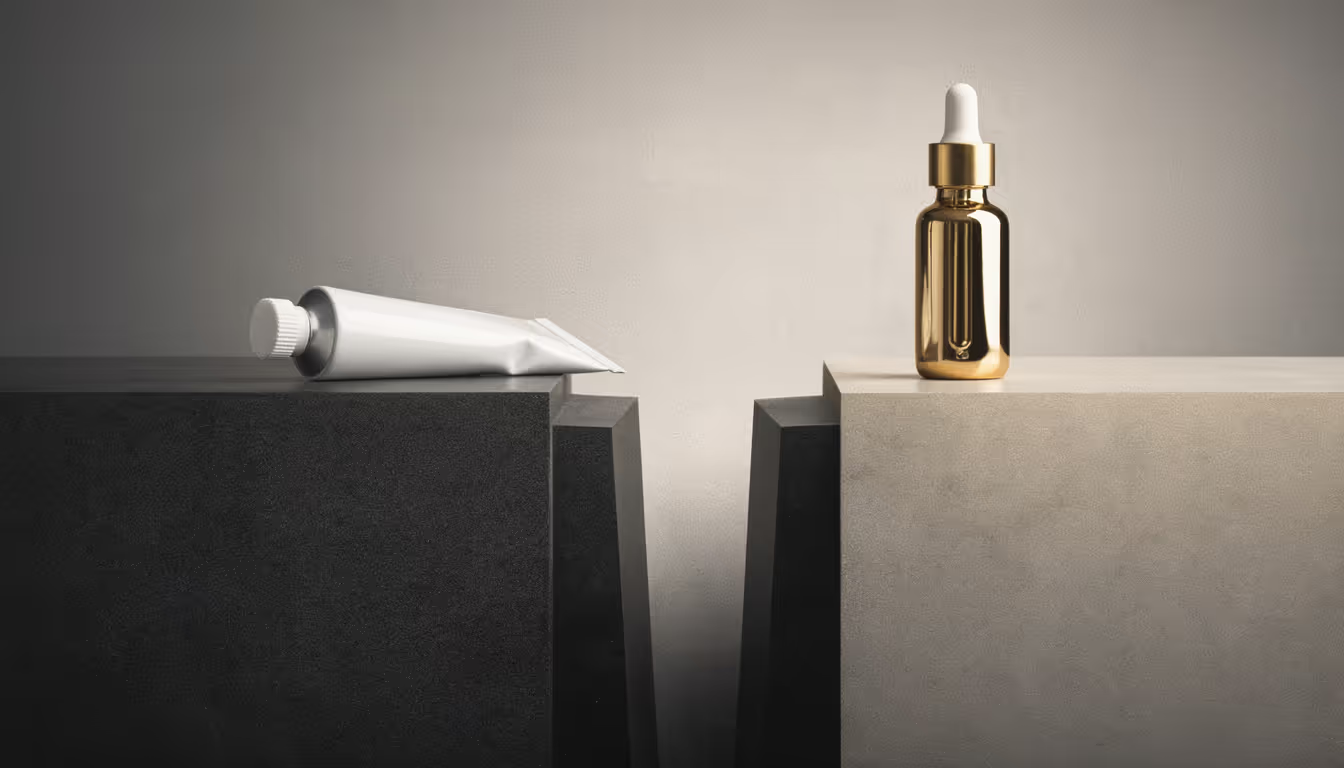



Why your €80 serum has less proof than a €15 prescription
Evidence vs. Marketing Series — Episode 1
There's a strange inversion happening in skincare.
A 20-gram tube of prescription tretinoin costs roughly €15–30 in most of Europe. A boutique retinol serum — beautifully packaged, influencer-endorsed — often runs €60–120 for a similar amount.
You might assume the expensive option has stronger evidence behind it. More research. Better proof it works.
You'd be wrong.
This is the retinoid evidence gap: a regulatory quirk that means the cheapest option on the market has decades of rigorous clinical trials, while the premium products have... marketing.
What retinoids actually are (briefly)
Retinoids are a family of vitamin A derivatives. They've been studied since the 1970s, and dermatologists consider them the closest thing skincare has to a proven anti-aging ingredient.
The family includes:
- Tretinoin (retinoic acid) — prescription-only, the "active" form your skin can use directly
- Retinol — over-the-counter, must be converted by your skin into tretinoin
- Retinaldehyde — one conversion step closer to tretinoin than retinol
- Retinyl palmitate — the weakest, requiring multiple conversion steps
Here's what matters: your skin can only use tretinoin. Everything else — retinol, retinaldehyde, retinyl palmitate — must be converted before it does anything. Each conversion step loses potency. Research suggests retinol is roughly 10–20 times less potent than tretinoin.
This isn't controversial. It's basic biochemistry.
The regulatory asymmetry
In the EU and US, cosmetics and pharmaceuticals live under completely different rules.
Prescription retinoids (tretinoin, tazarotene) had to prove they work before anyone could sell them. Randomised controlled trials. Placebo groups. Statistical significance. Peer review. Years of testing before approval.
Cosmetic retinoids (retinol, retinyl palmitate) don't need to prove anything. As the FDA states plainly: "The law does not require cosmetic products and ingredients, other than color additives, to have FDA approval before they go on the market."
The EU is slightly stricter on safety — the 2024 regulations now cap retinol at 0.3% in leave-on products — but efficacy testing? Still not required.
This means a company can launch a retinol serum tomorrow with zero clinical trials. They can call it "clinically inspired" or "dermatologist-developed" or "backed by science" without ever having tested whether it actually reduces wrinkles.
As a 2022 review in Advances in Therapy put it bluntly: "Since clinical efficacy studies are not required for marketing cosmetic formulations, there are concerns about the efficacy of these retinoids."
What the clinical evidence actually shows
Let's look at what happens when researchers do examine cosmetic retinoids rigorously.
A 2021 systematic review in the Journal of Clinical and Aesthetic Dermatology searched for all randomised, double-blind, vehicle-controlled trials of over-the-counter retinol for facial skin aging.
They found nine studies.
Of those nine:
- Four showed no statistically significant difference between retinol and placebo
- The remaining five showed only weak evidence for mild improvement in fine wrinkles
- All five "positive" trials had major methodological flaws
The review's conclusion was stark: "The 'positive' trials should not inform clinical decision-making but rather may serve as tools for advertising and marketing."
Compare this to tretinoin. A 2025 meta-analysis in Scientific Reports analysed 23 randomised controlled trials involving 3,905 participants. Tretinoin showed significant improvements in fine wrinkles, coarse wrinkles, and hyperpigmentation — with the most favourable safety profile of all treatments studied.
A separate 2025 meta-analysis focusing specifically on tretinoin examined 8 RCTs with 1,361 patients and found statistically significant improvements in both fine wrinkles (p<0.001) and coarse wrinkles (p<0.001).
This isn't a close contest. It's a chasm.
The stability problem nobody talks about
Even if a retinol product could work, there's another issue: it might have degraded before you finish the bottle.
A 2020 study in the Journal of Cosmetic Dermatology tested 12 commercial retinoid products over six months. The findings were quietly damning:
- At room temperature (25°C), retinoid content declined by 0–80% within six months
- Under slightly warmer conditions (40°C), degradation reached 40–100%
- The average shelf life — defined as 90% of the retinoid remaining — was just two months
- All products promised 6–12 month shelf life after opening
Light exposure accelerated degradation further. And crucially, formulation mattered more than concentration — expensive products weren't necessarily more stable than cheap ones.
So that retinol serum you bought six months ago? There's a reasonable chance much of the active ingredient is already gone.
Tretinoin has stability issues too — it's notoriously light-sensitive. But prescription products are formulated under pharmaceutical standards, with stability testing requirements that cosmetics don't face.
The price paradox
Here's where it gets absurd.
Generic tretinoin costs approximately €15–30 for a 20-gram tube in most European countries. In the US, generic tretinoin runs $20–40.
A "luxury" retinol serum from a prestige brand? Often €80–150 for 30ml.
The retinol beauty products market was valued at over $1 billion in 2023 and is projected to nearly double by 2034. Anti-aging retinol skincare alone represents a $5+ billion market growing at nearly 7% annually.
This is a multi-billion-dollar industry built largely on products that:
- Haven't been required to prove they work
- May have degraded before you use them
- Contain an ingredient 10–20 times weaker than the prescription alternative
- Cost 3–5 times more
What this means for you
We're not saying retinol doesn't work at all. The molecular mechanisms are sound — retinol can be converted to tretinoin in skin, and can trigger similar cellular changes. Some well-formulated products, used consistently, probably deliver modest benefits.
But "probably delivers modest benefits" is a long way from "clinically proven to reduce wrinkles."
If you want evidence-based anti-aging, the research points clearly to prescription retinoids:
- Tretinoin has the deepest evidence base and best safety profile
- Tazarotene is most effective for deeper, coarse wrinkles (though more irritating)
- Both require a prescription and proper guidance on use
If you prefer to stay over-the-counter, that's a valid choice — maybe you have sensitive skin, you're not ready for prescription-strength irritation, or you simply prefer the convenience. Just know what you're buying: a product category where efficacy testing isn't required, stability is questionable, and the evidence base is thin.
The uncomfortable question
When you pay €100 for a retinol serum, what exactly are you paying for?
Not clinical trials — those weren't required. Not guaranteed stability — that wasn't tested to pharmaceutical standards. Not greater efficacy — the active ingredient is inherently weaker.
You're paying for packaging. Marketing. The feeling that expensive must mean effective.
Meanwhile, the unglamorous prescription option — clinically proven, rigorously tested, and significantly cheaper — sits in pharmacies, largely overlooked.
This is what the evidence gap looks like in practice. It's not a conspiracy. It's just regulatory asymmetry meeting good marketing.
And once you see it, you can't unsee it.
A note on availability: What can you actually get in Belgium?
Here's the practical reality for Belgian readers: even if you want to follow the evidence to prescription retinoids, your options look different than in the US.
Tretinoin — the most-studied retinoid — isn't available as a branded standalone product in Belgium. The commercial option is Treclinax, which combines tretinoin with clindamycin (an antibiotic). It's designed for acne treatment, not long-term anti-aging use — you can't use an antibiotic continuously.
However, there's a workaround: your dermatologist can prescribe tretinoin as a magistrale bereiding (compounded preparation). The BCFI specifically mentions "Crème hydrophile à 0,05% de trétinoïne FTM" as an example. This is pure tretinoin cream, made by a compounding pharmacy to your doctor's prescription. Ask your dermatologist — this option exists.
Adapalene (Differin) is readily available at €24 for 60g in cream or gel form (0.1%). A 2018 clinical trial found adapalene 0.3% gel showed comparable efficacy to tretinoin 0.05% cream for photoaging over 24 weeks — similar improvements in wrinkles, pigmentation, and overall photodamage. The Belgian formulation is 0.1%, which is gentler but still effective. It's more photostable than tretinoin, better tolerated, and a solid evidence-based choice for most people.
Trifarotene (Aklief) is the newest option — a fourth-generation retinoid available in Belgium at €42 for 75g. It's RAR-γ selective, meaning it targets the receptor most abundant in skin. Originally approved for acne (including body acne), it's showing promise for photoaging. More photostable than tretinoin. Worth discussing with your dermatologist if you want something newer.
For all three: expect improvement only after two months or more. Initial worsening of skin is normal. Sun protection is essential. Apply once daily in the evening to clean, dry skin.
For those willing to look further: Tazarotene
Tazarotene deserves special mention. The 2025 network meta-analysis ranked it the most effective retinoid for coarse wrinkles — stronger than tretinoin. It's not marketed in Belgium, but it is available without prescription in Greece and Spain under the brand name Tazarene by Boderm, in both 0.05% and 0.1% strengths.
A search for "Tazarene 0.05 Boderm" or "Tazarene 0.1 Boderm" will point you in the right direction. Whether traveling or ordering from European pharmacies that ship internationally, this is worth knowing if you want the strongest evidence-backed option for deeper wrinkles.
Be aware: tazarotene is more irritating than adapalene or tretinoin. Start with the 0.05% strength, use sparingly, and build tolerance slowly.
This is Episode 1 of our Evidence vs. Marketing series, where we examine what 2025 research actually shows about popular skincare ingredients and devices. Coming next: Collagen Supplements — Expensive Placebo?