



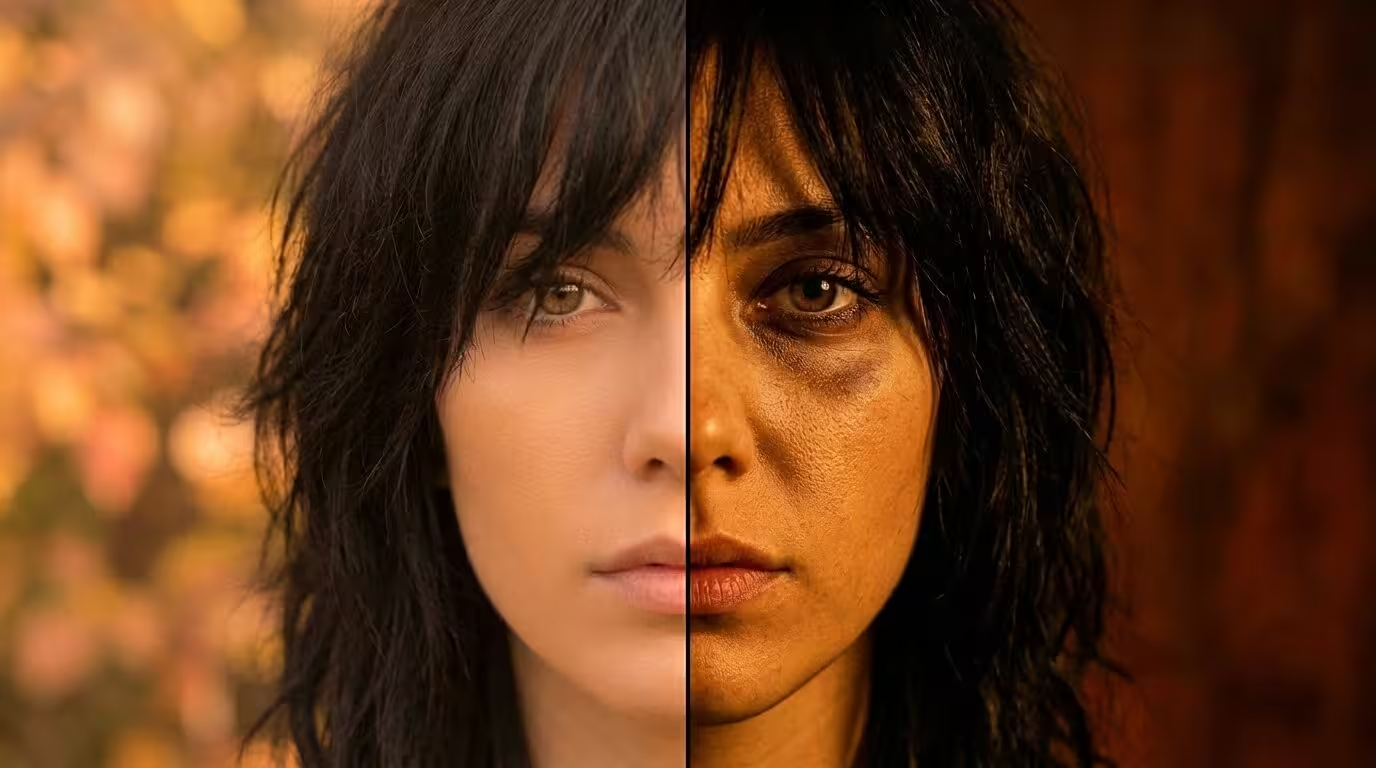



You're scrolling through a clinic's Instagram. A woman's face, side by side: before on the left, after on the right. The transformation is striking — the jawline sharper, the skin luminous, the years seemingly reversed. You feel something shift. Hope, maybe. Curiosity. The thought: that could be me.
You screenshot it. You DM the clinic. You book a consultation.
But the woman in the before photo was photographed under fluorescent lighting, without makeup, at the end of a long day. The after photo was taken in a professional studio with diffused lighting, a reflector, a full face of cosmetics, and a smile. The angle shifted fifteen degrees. The background colour changed. The images may have been taken months apart — or by entirely different photographers.
The question is not whether she looks better in the second photo. Of course she does. The question is how much of that difference was created by the procedure — and how much was created by the photography.
If you've ever saved a before-and-after image and thought I want that result, you weren't being naïve. You were responding exactly the way the image was designed to make you respond. The issue isn't your judgment. It's the system producing those images.
In 2021, a research team at Northwestern University published what remains the most systematic analysis of before-and-after photography on social media in aesthetic medicine. Vaca and colleagues examined 291 of the most-engaged-with Instagram posts involving facial cosmetic procedures, assessing each image pair for sixteen types of photography bias: lighting, angles, backgrounds, expressions, makeup, and more.
The result: 97% of posts showed photography bias favouring the after image. Not fifty percent. Not seventy. Ninety-seven.
If you've browsed ten before-and-after posts this week, the research says roughly all ten were photographically tilted to make the result look better than a neutral comparison would show.
And the accounts with greater photography bias had significantly more followers. The algorithm doesn't reward honesty. It rewards aesthetics — which, when the product is aesthetics, creates a feedback loop with no natural corrective. The system patients rely on to evaluate results is structurally incentivised to mislead them.
The manipulation playbook
A follow-up study by ElAbd and colleagues in 2023 analysed 161 before-and-after image pairs from the top plastic surgery accounts on Instagram. They found that 70.8% showed measurable photographic manipulation — background changes, angle changes, and patient position shifts being the most significant. One common technique: photographing the patient standing in the before image and lying down in the after. Lying down redistributes soft tissue under gravity. It is not a surgical result.
None of this requires Photoshop. It requires only a willingness to photograph the before image badly and the after image well. Harsh overhead light versus warm studio light. A downward angle versus a level one. Hair pulled back versus styled. A frown versus a smile — which alone can lift the midface and brighten the entire appearance without a single intervention.
Once you know this, you can't unsee it. Go back to any before-and-after gallery and look — not at the face, but at the frame. The lighting. The angle. The expression. You'll start noticing.
Board-certified plastic surgeons made up only 27.5% of the practitioners behind the most-engaged-with posts. That's not, in itself, an indicator of bad practice — but it means the images most people see are disproportionately produced by accounts with the strongest commercial incentives. Not a reason to distrust everyone. A reason to verify what you're looking at before you let it shape your expectations.
The patient cost
Here is where the data becomes personal.
Wanting to change something about your appearance is not a disorder. It's not vanity. For many people, aesthetic procedures are a considered decision that leads to genuine satisfaction. The science supports that — most patients are pleased with their outcomes when expectations were realistic and the practitioner was skilled.
But the gap between curated imagery and clinical reality has measurable consequences for the patients who fall into it.
A team led by Watchmaker published an interesting study in 2020, analysing unfavourable online reviews of minimally invasive and non-invasive cosmetic procedures. The most frequently cited reason for dissatisfaction, at 65%, was perceived ineffectiveness — the sense that the result did not match what was expected. Not that the procedure caused harm. Not that the recovery was difficult. That the outcome didn't look like the picture.
One patient described it to us simply. She'd booked a Hydrafacial — her first aesthetic treatment. On Instagram, the results she'd seen looked incredible: glowing skin, smaller pores, an instant visible change. What she got wasn't bad — her skin was hydrated, and that was real. But it was nowhere near what she'd seen online. Looking more carefully at the clinic's photos afterward, she noticed what she hadn't before: the "after" images were taken immediately post-treatment, with serums still on the skin, making it look dramatically more luminous. The blemishes that seemed to vanish? Retouching. The transformation was real in the photograph. It just wasn't real on the face.
This wasn't malpractice. It was a perfectly fine treatment marketed with images that made a modest, honest result look like a transformation — and a patient who had no reason to doubt what she was seeing until she lived the difference herself.
Honigman and colleagues explored this pattern in a broader systematic review, finding that unrealistic expectations are one of the strongest predictors of poor psychological outcome after cosmetic procedures. Patients who arrive with expectations shaped by manipulated imagery are arriving with unrealistic expectations — not because they're unreasonable people, but because the information they were given was unreasonable.
There is also a more vulnerable population within this picture. An estimated 15% of patients presenting for cosmetic procedures may meet criteria for body dysmorphic disorder — a condition characterised by obsessive preoccupation with perceived flaws that others don't notice. This is a clinical condition, not a character flaw, and it exists on a spectrum that many people move along at different points in their lives. Most people who feel dissatisfied with some aspect of their appearance do not have BDD. But among those who do, cosmetic surgery often fails to resolve the underlying distress.
Manipulated imagery does not cause BDD. But it creates an environment where the condition is more likely to be triggered and left unrecognised — because the gap between self-perception and the images on screen feels normal when everyone else seems to be achieving those results.
Seventy percent of young adult women and sixty percent of young adult men now report body dissatisfaction. Dermatologists have coined the term "Snapchat dysmorphia" to describe patients arriving with filtered selfies as their aesthetic reference point. If you've ever held up a filtered photo of yourself and thought this is the version I want to be — you're not alone, and you're not wrong to want that. But it matters enormously whether the image you're comparing yourself to was ever achievable in the first place.
What happened at Allure Esthetic, Seattle
In July 2024, a Seattle-based plastic surgery clinic agreed to a $5 million settlement with the Washington State Attorney General. The case against Allure Esthetic reads like a catalogue of every practice described in the research above — except this time, there were internal documents and employee testimony.
Staff described being directed to digitally alter before-and-after photos to exaggerate results — including, in one account, moving the position of a patient's nipples in breast augmentation images to create a more symmetrical appearance. Patients were required to sign non-disclosure agreements as a condition of care, with penalties of up to $250,000 for posting negative reviews. When critical feedback appeared anyway, the clinic filed legal threats and HIPAA complaints against the patients themselves — turning privacy law into a silencing tool. Staff also created fake positive reviews using fabricated personas, posted from VPN-masked IP addresses.
This was not a first offence. The practice had been disciplined for false advertising as far back as 2008. The $5 million penalty and mandatory removal of all misleading imagery made the case precedent — and a warning.
The case also illustrates a broader dynamic. A 2022 survey of members of the British Association of Aesthetic Plastic Surgeons found that over half had experienced denigration of their professional reputation through digital channels, and over three-quarters had been subjected to patient blackmail attempts related to fees. The ecosystem is polluted in both directions. But the deepest irony is this: the practitioners who manipulate their imagery are the least likely to face reputational consequences, because their patients' expectations were never grounded in reality. The practitioners who photograph honestly are the most vulnerable to unfavourable comparisons — because honest work looks less impressive next to dishonest marketing. The doctors who don't manipulate their photos may be the ones worth trusting most.
The other deception: fake reviews
Before-and-after photos are not the only tool of manufactured credibility. Fake reviews are the other pillar.
A patient researching aesthetic procedures typically starts with two things: images and reviews. Studies consistently show that the vast majority of consumers consult online reviews before choosing a healthcare provider. If the images are manipulated and the reviews are fabricated, the patient is making a decision on the basis of two fictions reinforcing each other.
The Allure case involved both — and patients who tried to post honest feedback were silenced through NDAs and legal threats. Imagine being in that position: dissatisfied with a result, unable to speak publicly, watching the clinic's rating climb while your experience is erased. That was the finding of a federal court.
The regulatory response is accelerating. The FTC's 2024 Consumer Review Rule explicitly prohibits fake reviews — including AI-generated ones — and makes suppression of negative reviews enforceable. Civil penalties of up to $53,088 per violation apply. In December 2025, the FTC issued its first enforcement sweep. In Belgium, fake patient testimonials are also prohibited under the 2013 law.
For patients, verification matters more than volume. A clinic with hundreds of uniformly glowing five-star reviews may be telling you less than one with a smaller, more varied portfolio that includes honest accounts of recovery and realistic outcomes. A five-star-only profile is not a sign of excellence. It may be a sign of curation.
What honest clinical photography looks like
Standards exist. They've existed for decades. They're specific, they're not difficult to implement, and they're simply not enforced.
Honest before-and-after documentation uses the same camera, lens, distance, and lighting in both images. Expressions are neutral. There's no makeup or styling change. The background and posture are identical. Multiple standard angles are taken. Timing after healing is clearly stated. There are no filters, no smoothing, no selective editing.
If an image doesn't meet these conditions, it isn't clinical evidence. It's marketing. And knowing the difference puts you in a stronger position when you walk into a consultation.
What this means for you
The biology of aesthetic medicine is real. Procedures work. Results can be genuinely transformative. Nothing in this article should discourage you from pursuing a procedure you've carefully considered with a qualified practitioner.
What is in question is whether the photograph you're using to make your decision reflects reality. And the research is unambiguous: in the vast majority of cases, it does not.
Before you book based on what you see online, ask these questions — not because you were wrong to trust what you saw, but because the system hasn't earned that trust yet:
Is the lighting identical in both images? Is the angle the same? Is the background the same? Is the expression neutral? Is there a makeup or grooming change? Are multiple views shown? Is the timing clearly stated? Do the images belong to this practitioner — you can reverse-image-search to check? Are the reviews plausible, or uniformly perfect? And most importantly: have you had an in-person consultation where realistic expectations were discussed — not curated — by someone with verifiable credentials?
If a result looks too good to be true, the research tells us it almost certainly is. But the answer isn't to distrust everything. It's to know what honest looks like — and to seek out the practitioners who aren't afraid to show you unmanipulated reality. They exist. They're often the best ones.
What the law already says
If the practices described in this article sound like they should be illegal — in several countries, they already are.
Belgium has the most unambiguous position in Europe. All advertising for aesthetic medical procedures — including before-and-after photos and patient testimonials — has been prohibited since 2015 under the Loi du 23 mai 2013. The distinction is clear: informing patients about a practitioner's credentials and services is allowed; persuading them to undergo a procedure is not. Before-and-after images are considered promotional by nature.
Despite this, enforcement remains inconsistent. The Royal Belgian Society for Plastic Surgery (RBSPS) has publicly called on authorities to apply the law more strictly, noting an influx of unqualified practitioners — some non-Belgian, some non-medical — performing injections in hotel rooms and beauty salons, promoted via social media, with no traceability and no follow-up. Some of these cases have resulted in deaths. If you are a patient in Belgium and you see a clinic posting before-and-after images on Instagram, what you are seeing is already illegal. The fact that it continues reflects a failure of enforcement, not of law.
France has sanctioned and suspended doctors for posting before-and-after images, treating such posts as impermissible advertising. A 2023 influencer law went further, banning cosmetic surgery promotion on social media entirely and requiring the labelling of retouched or AI-generated images. Penalties run up to €300,000 and two years' imprisonment. In practice, French practitioners acknowledge operating in a grey zone — many post clinical photography on Instagram, arguing it's information, not promotion. The Ordre des Médecins disagrees.
Germany provided a significant judicial precedent in 2024. The Higher Regional Court of Hamm ruled that the existing ban on before-and-after images extends beyond surgery to injectable treatments — hyaluronic acid fillers and botulinum toxin. The first appellate ruling in Germany to apply the advertising ban to non-surgical aesthetics.
Canada and the UK impose varying restrictions. In Ontario, before-and-after photos are prohibited in advertising where patients would encounter them unsolicited — though they may appear on a practitioner's own website with written consent. The UK's Advertising Standards Authority has banned before-and-after images for prescription-only treatments. In both jurisdictions, medical bodies warn that before-and-after galleries are inherently biased and create medico-legal risk.
In the United States, the FTC enforces truth-in-advertising standards, and some states require disclosure when displayed images aren't the practitioner's own. Misleading marketing can ground a misrepresentation claim — separate from malpractice, requiring proof of deception, not negligence.
The pattern across jurisdictions is consistent: no agency pre-approves what a clinic posts. Enforcement happens after the fact. Legal protection exists, but it doesn't prevent you from seeing manipulated images. It only punishes them after you've already been influenced.
We launched fakebeforeafter.com as a public education resource — a place for patients to learn how manipulated before-and-after imagery works and how to recognise it. We believe that transparency in aesthetic medicine serves everyone: patients who deserve honest information, and ethical practitioners whose work speaks for itself. If you are a professional who photographs honestly and wants to contribute to the conversation, we want to hear from you.